Word Farm Adventure: Word Game
- 4.9
- Rating
- 5.00M
- Installs
- Free
- Price
 Analysis by App-foxy
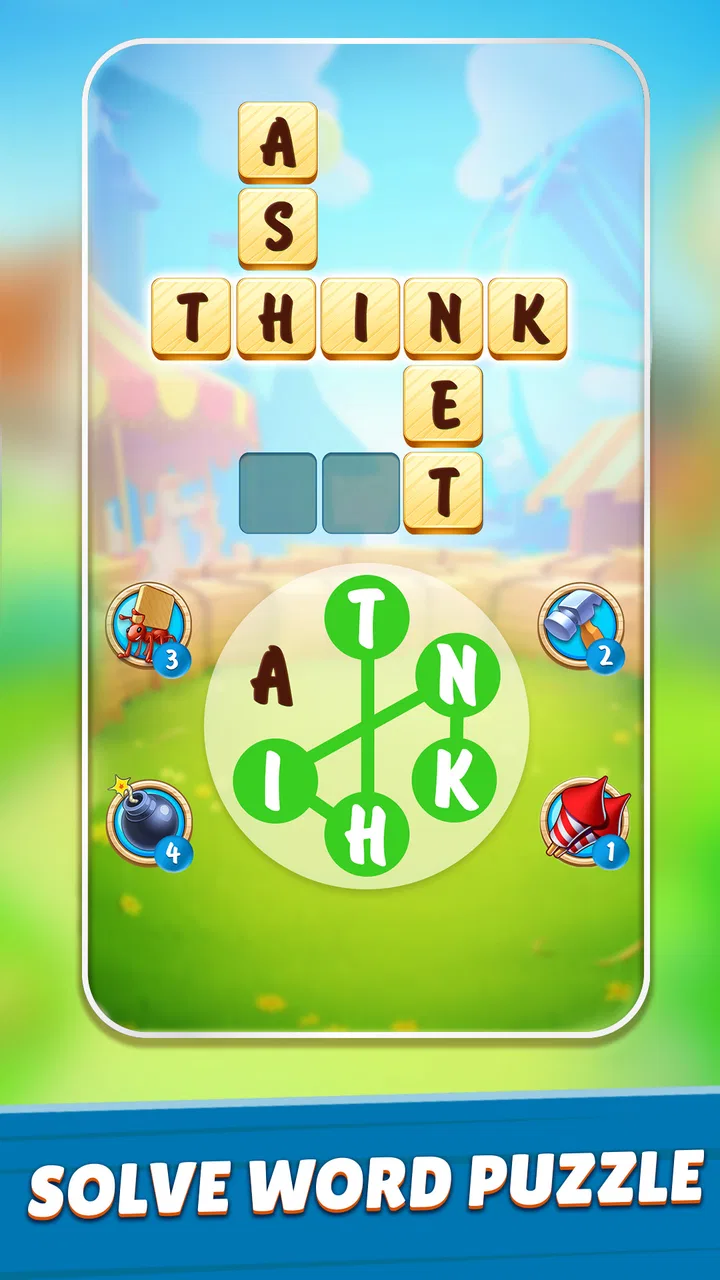
Word Farm Adventure: Word Game is the kind of word puzzle game I can open for a short break and still feel that I have made some progress when I put it down. Its central appeal is simple: solve word puzzles, keep your mind active, and move through an adventure-shaped experience rather than working through an endless pile of unrelated exercises. I reviewed it as a casual player who enjoys vocabulary challenges but does not always want a demanding, formal brain-training session.
That balance is the most interesting part of the game. It is free to start, aimed at Everyone, and made by Mad Brain Games LTD, so it is clearly designed for broad, everyday play rather than a specialist audience. The store summary presents it as a way to challenge your brain through online learning and word puzzles, but what matters in practice is how those puzzles create a reason to return. The game works best when you enjoy small goals, visible movement, and the satisfaction of finding a word that was hiding in plain sight.
How the first goals make the game easy to enter
The opening experience is approachable because the basic activity is immediately understandable. You are not asked to learn a complicated control scheme or manage a large collection of systems before solving anything. The early goals give the game a clear rhythm: look at the available letters or word challenge, think through possible answers, complete the puzzle, and continue toward the next piece of progress.
You May Also Like

 Blood Strike: 2.5 Anniversary
Blood Strike’s Loadouts Turn Every Drop Into a Tactical Gamble
A close look at Blood Strike’s custom loadouts: how fast access to signature weapons reshapes its battle royale rhythm, rewards preparation, and narrows the gap between fights.

 Pandora - Music & Podcasts
Pandora’s Music Is Easy to Start, but Harder to Recover
Pandora’s strength is its low-effort path from a seed to a station. Its weak spot is how much confidence it asks you to place in connection, setup, and quiet recovery.

 8 Ball Pool
 Is Built on Rivalries, Rematches, and Routine
A close look at the rivalries, rematches, shared routines, and unanswered safety questions that turn a quick pool match into a persistent mobile community.

 Samsung Music
’s Quiet Strength Is Playing What You Already Own
Its reach comes less from spectacle than from dependable access to a personal library. That simplicity is both the app’s strongest retention engine and its ceiling.

 AccuWeather: Weather Radar
AccuWeather Review: A Quick, Clear Forecast for Everyday Decisions
For everyday plans, the best forecast is the one you can understand quickly. AccuWeather makes rain timing, radar, and local conditions easy to act on, with a few trade-offs.

 Hill Climb Racing
Why Hill Climb Racing Still Turns Crashes Into One More Run
A tiny car, a bumpy hill and one more upgrade: Hill Climb Racing keeps resurfacing because its simple chaos makes every near-miss feel personal.
More From Our News Desk



I like that this structure gives a new player something more useful than a blank menu. A pure word grid can feel disposable after a few rounds, especially when the only reward is a score. Here, the adventure framing gives each solved puzzle a little more purpose. Even if you only have a few minutes, you can finish a challenge and feel that the session moved forward.
The early stages are also a good test of whether the game suits your habits. If you like discovering words, testing combinations, and gradually becoming more confident, the initial goals are inviting. If you prefer crossword-style clues, strict dictionary play, or completely open-ended vocabulary practice, the game may feel more guided than you expect. It is not trying to replace every other word-game format; it offers a particular mix of puzzle solving and casual progression.
My practical recommendation is to play the first sessions without rushing. The temptation is to treat every puzzle as something to clear as quickly as possible, but pausing to look for shorter words, alternate patterns, and familiar endings makes the experience more enjoyable. That approach also helps later, when a puzzle stops giving away its solution so easily.
Why the adventure framing matters
The adventure presentation is not just decoration from a player’s point of view. It changes how I judge a difficult round. In a standalone word puzzle, failing to see an answer can feel like the entire point of the session has stalled. In this game, the broader sense of moving through an adventure makes one stubborn puzzle feel like a temporary obstacle rather than a dead end.
That is especially useful for people who play during ordinary downtime: waiting for an appointment, taking a short break, or settling down before bed. I can play a few rounds without needing to remember a complicated storyline or prepare for a long session. The game’s early goals are small enough to fit around real life, which is one of its strongest qualities.
There is a trade-off, though. Players who want a deep narrative may find that the word challenges are the real attraction and that the adventure layer mainly provides motivation. I would not choose this title for storytelling alone. I would choose it when I want vocabulary play to feel more directed than a simple daily word puzzle.
Progress signals that keep a short session meaningful
Good casual puzzle design depends on clear progress signals. I want to know whether I am improving, whether I am close to completing a goal, and whether the next round will offer something different. Word Farm Adventure communicates progress through the act of completing puzzles and advancing through its adventure-oriented structure. That is enough to make a ten-minute session feel deliberate instead of random.
The game’s rating gives some context for its broad appeal: it holds a 4.9 average from around 82 thousand ratings, with roughly 15 thousand written reviews. I do not treat that as proof that every player will enjoy it, but it does match my impression that the basic loop is easy to understand and satisfying for many casual word-game fans. It has also passed five million installs, which places it well beyond the scale of a tiny experimental puzzle.
One useful way to play is to separate “completion” from “mastery.” Completing the expected word challenge is the immediate goal, while noticing extra possibilities, solving with fewer hints if available, or recognizing recurring word structures can become your personal improvement target. I found that this creates a healthier pace than trying to force every session into a perfect performance.
Another small but important insight is that progress feels better when I stop at a natural point. Because word games invite “just one more round,” it is easy to turn a relaxing break into a tiring search for a solution. Finishing a puzzle and leaving before frustration builds preserves the game’s strongest loop. When I return later, the challenge feels fresh rather than like unfinished homework.
Using the game as a light learning tool
The learning angle works best when treated as incidental practice, not as a replacement for a structured language course. Solving word puzzles makes me pay attention to spelling, prefixes, suffixes, and the way letters combine. That can be useful for younger players, casual learners, or anyone who enjoys keeping vocabulary active, but the experience remains a game first.
I would be comfortable recommending it for a family member who wants gentle word practice and does not need a formal lesson plan. The Everyone content rating supports that broad audience. Still, an adult learner seeking pronunciation work, grammar explanations, or a carefully sequenced language curriculum should choose a dedicated learning app instead. The puzzle format can reinforce recognition, but it cannot cover every part of language learning.
The minimum operating-system requirement is 10, so anyone using an older device should check compatibility before planning to play. On supported phones and tablets, the current version is 7.18.0. I mention this because compatibility is a practical part of the decision: a well-designed puzzle is not useful if the device cannot run the current release comfortably.
How the difficulty curve changes the mood
The difficulty curve is where casual word games either become habit-forming or lose me. If every round is obvious, I stop thinking. If the game becomes obscure too quickly, the experience turns into repeated guessing. Word Farm Adventure is most enjoyable when I treat the easier puzzles as a warm-up and expect the later challenges to require a more systematic approach.
My preferred method is to scan for common short words first, then look for longer combinations and familiar word endings. I also try not to commit too early to the first pattern I notice. A word that seems obvious can use letters needed for a better answer, and stepping back for a few seconds often reveals a more efficient route.
This is one of the game’s non-obvious strengths: it rewards a change in attention more than raw speed. When stuck, I do not necessarily need more vocabulary. I may need to rearrange the letters mentally, stop focusing on one possible beginning, or work backward from a likely ending. That makes the challenge feel thoughtful without requiring specialist knowledge in every round.
There will still be moments when the solution feels less satisfying than the surrounding puzzles. Word games are naturally sensitive to personal vocabulary, regional usage, and the words a player happens to recognize. A puzzle that is easy for one person can be irritating for another. I consider that a normal limitation of the format, but it means players who dislike ambiguity or unfamiliar vocabulary should approach with patience.
When hints and purchases affect the experience
The game is free, which makes it easy to try without committing money. It also includes in-app purchases ranging from $0.49 to $99.99 per item. That wide range is worth noticing before playing for a long time. I would not spend simply because a single puzzle has become annoying; I would first take a break, revisit the letter pattern, and decide whether I am enjoying the challenge or merely trying to remove an obstacle.
For me, the best way to preserve the game’s value is to treat help as an occasional convenience rather than the default solution. Using assistance too quickly can weaken the central satisfaction of discovery. On the other hand, a carefully chosen hint can keep a short session moving when I am genuinely stuck and do not want to abandon the game.
This creates a clear trade-off. Players who want a completely uninterrupted, no-purchase puzzle experience may prefer a paid word game with a fixed structure. Players who appreciate free access and are comfortable ignoring optional spending can enjoy this one without paying. I would especially advise parents to discuss purchases before handing the device to a child, even though the content rating is Everyone.
What brings players back, and where the pressure appears
The retention loop is built around the feeling that another puzzle is close at hand and that solving it will continue the adventure. That is a strong reason to return because the required commitment is small. I do not need to reserve an hour; I can make progress during a spare moment and stop when I have had enough.
The same design can create pressure if I let completion become the only measure of a good session. A difficult round can make me feel that I must continue until the path is clear, even when I am no longer enjoying the process. My solution is to set a simple boundary: one or two puzzles during a break, then stop regardless of whether the next challenge looks tempting.
This game is a particularly good fit for people who enjoy gentle, repeatable goals. It is less suitable for players who need constant novelty, competitive multiplayer, or a large strategic layer beyond word solving. The adventure structure gives context, but it does not transform the game into a role-playing game or a strategy title. Its appeal remains concentrated in the word puzzles.
I also would not recommend it as the only game for someone who wants measurable language improvement. It can support attention to spelling and word formation, but its motivation comes from play. For a student preparing for an exam, a vocabulary trainer with deliberate review schedules would be more appropriate. For someone who wants to relax while still exercising their brain, this game is much closer to the right choice.
A realistic everyday use case
Imagine having a fifteen-minute wait before a train or appointment. I would open the game, complete a few manageable word puzzles, and stop after reaching a clear progress point. If one challenge became stubborn, I would avoid spending immediately: I would switch from searching for long words to checking short combinations, then return to the puzzle after a minute away from the screen.
That workflow makes better use of the game than playing continuously until every available goal is exhausted. It keeps the adventure feeling like a series of pleasant stops rather than an obligation. The same approach works before bed, although anyone who finds puzzle solving mentally stimulating may prefer not to play when they are trying to wind down.
My progression verdict
After looking at the full progression experience, I see Word Farm Adventure: Word Game as a polished casual option for people who want word puzzles with a stronger sense of direction than a basic daily grid. Its early goals are welcoming, its progress is easy to understand, and its difficulty becomes more interesting when I slow down and use deliberate letter-search habits instead of guessing randomly.
The progression does not remove every frustration. Some puzzles may clash with your vocabulary, and the presence of purchases means players should be conscious of how they respond to difficult moments. The game also cannot satisfy someone looking for deep narrative, competitive play, or formal language instruction. Those are not small details; they define who should skip it.
For my own use, the best audience is a casual word-game player who likes short sessions, visible advancement, and a light learning flavor. I would recommend trying it free, deciding early whether the adventure framing adds motivation, and keeping hints or purchases as optional tools rather than necessities. The Everyone rating makes it broadly approachable, while the current version and substantial player base suggest an established game rather than a brief novelty.
Mad Brain Games LTD has built a word game that understands a simple truth: solving one more puzzle is more appealing when it feels connected to somewhere. The progression is strongest when it supports your curiosity without turning every difficult word into a demand to keep playing. If that sounds like the kind of relaxed challenge you want, this is an easy title to try; if you prefer fixed-price puzzles, rigorous learning plans, or more strategic depth, another option will probably serve you better.
FAQs for Word Farm Adventure: Word Game
01What is Word Farm Adventure: Word Game?
Word Farm Adventure is a word puzzle game that combines word search challenges with farm-building gameplay. Players solve word puzzles to earn resources, which are then used to renovate and decorate a farm. This game is available for both Android and iOS devices, offering an engaging mix of vocabulary challenges and creative farming tasks.
02Is Word Farm Adventure free to play?
Yes, Word Farm Adventure is free to download and play on both Android and iOS platforms. However, the game includes in-app purchases and ads. Players can buy coins or other resources to enhance their gaming experience, but these purchases are optional and not necessary to enjoy the game fully.
03What are the key features of Word Farm Adventure?
Key features of Word Farm Adventure include a wide variety of word puzzles, farm-building gameplay, and daily challenges. The game offers hundreds of levels with increasing difficulty, allowing players to improve their vocabulary and problem-solving skills. Additionally, players can customize their farms with unique decorations and upgrades.
04Do I need an internet connection to play Word Farm Adventure?
While Word Farm Adventure can be played offline, some features may require an internet connection. Online connectivity is needed for certain updates, events, and to sync progress across devices. However, the core gameplay, including solving word puzzles and farm building, can be enjoyed without an internet connection.
05How does Word Farm Adventure ensure player privacy and data security?
Word Farm Adventure follows strict privacy policies to ensure player data is secure. The game collects minimal personal information, mainly for improving gameplay and providing a personalized experience. Players are encouraged to review the app’s privacy policy, available on its download page, to understand how their data is managed and protected.
Pros
- Engaging puzzles keep the mind active.
- Visually appealing graphics and design.
- Frequent updates with new content.
- Family-friendly and suitable for all ages.
- Offline play available for on-the-go fun.
Cons
- In-app purchases can be pricey.
- Some ads are intrusive and frequent.
- Puzzles may become repetitive over time.
- Requires a stable internet for updates.
- Limited language options for word play.

Word Farm Adventure: Word Game
Gallery